
Last updated September 10, 2026
Full 25-point door and opener safety check with every visit - springs, cables, rollers, tracks, and your LiftMaster or Chamberlain opener included
You get a price before we start. It does not change when the truck arrives.
 Before
 After
After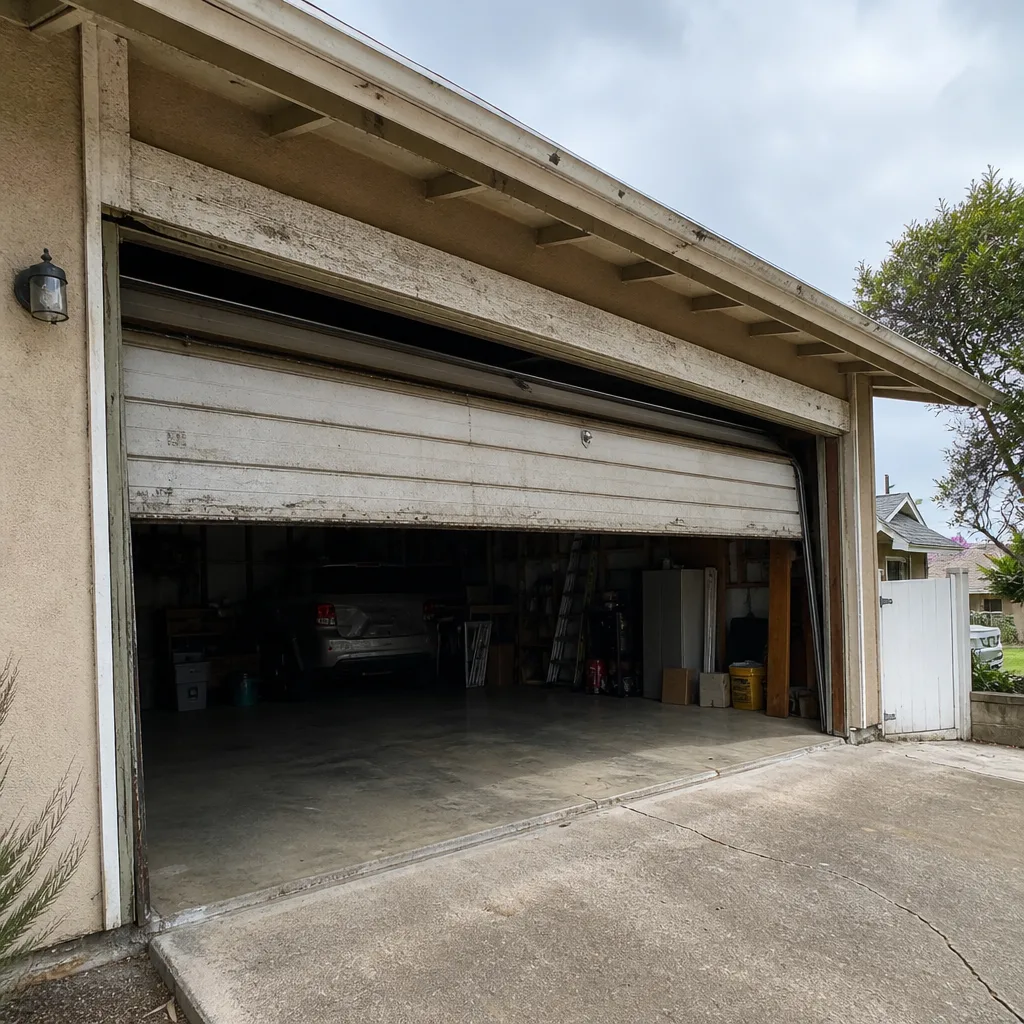 Before
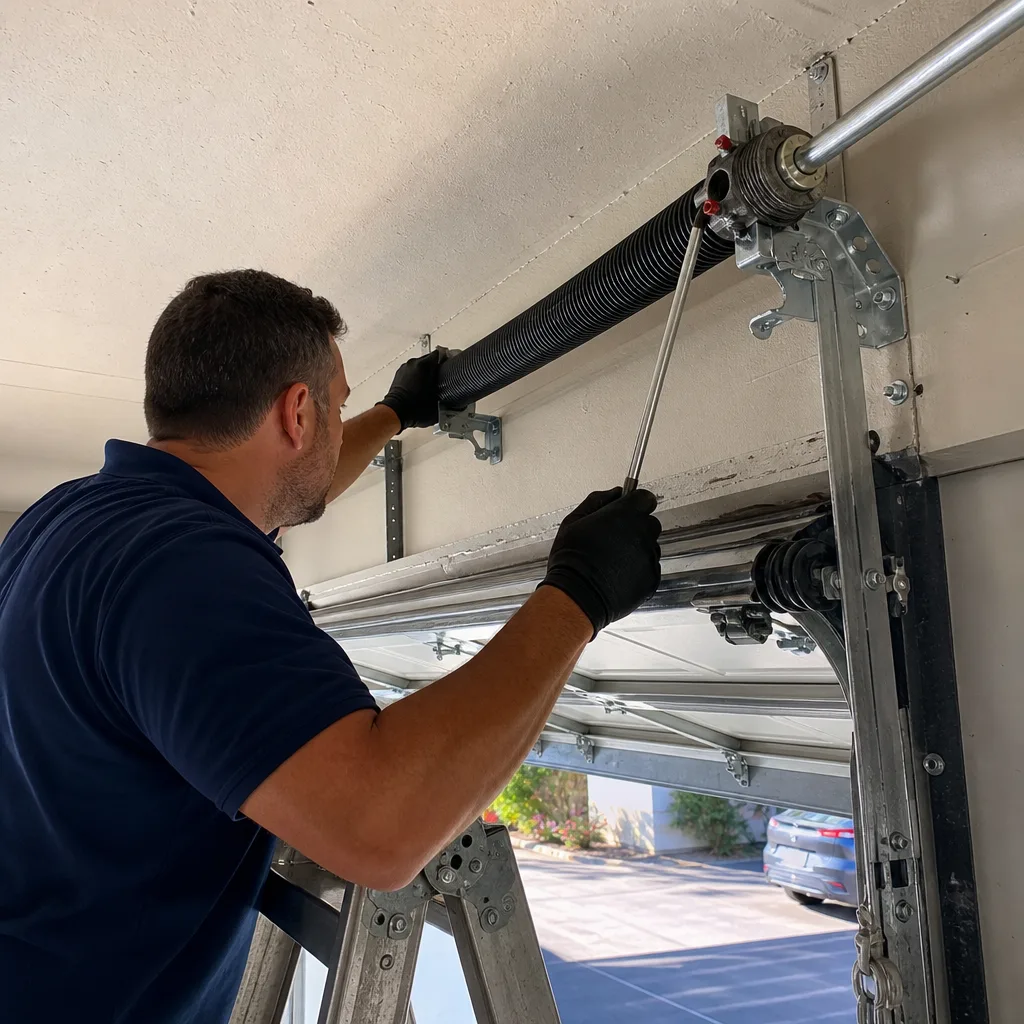 After
After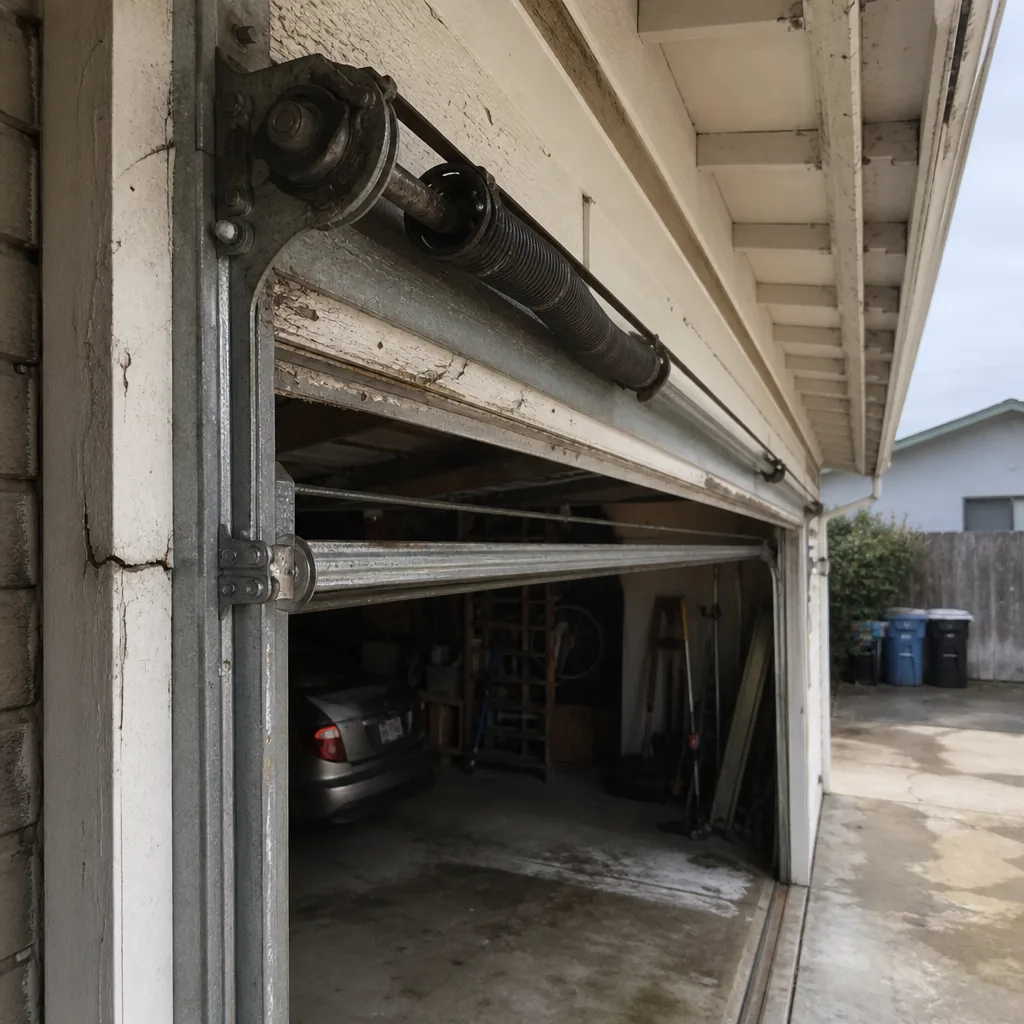 Before
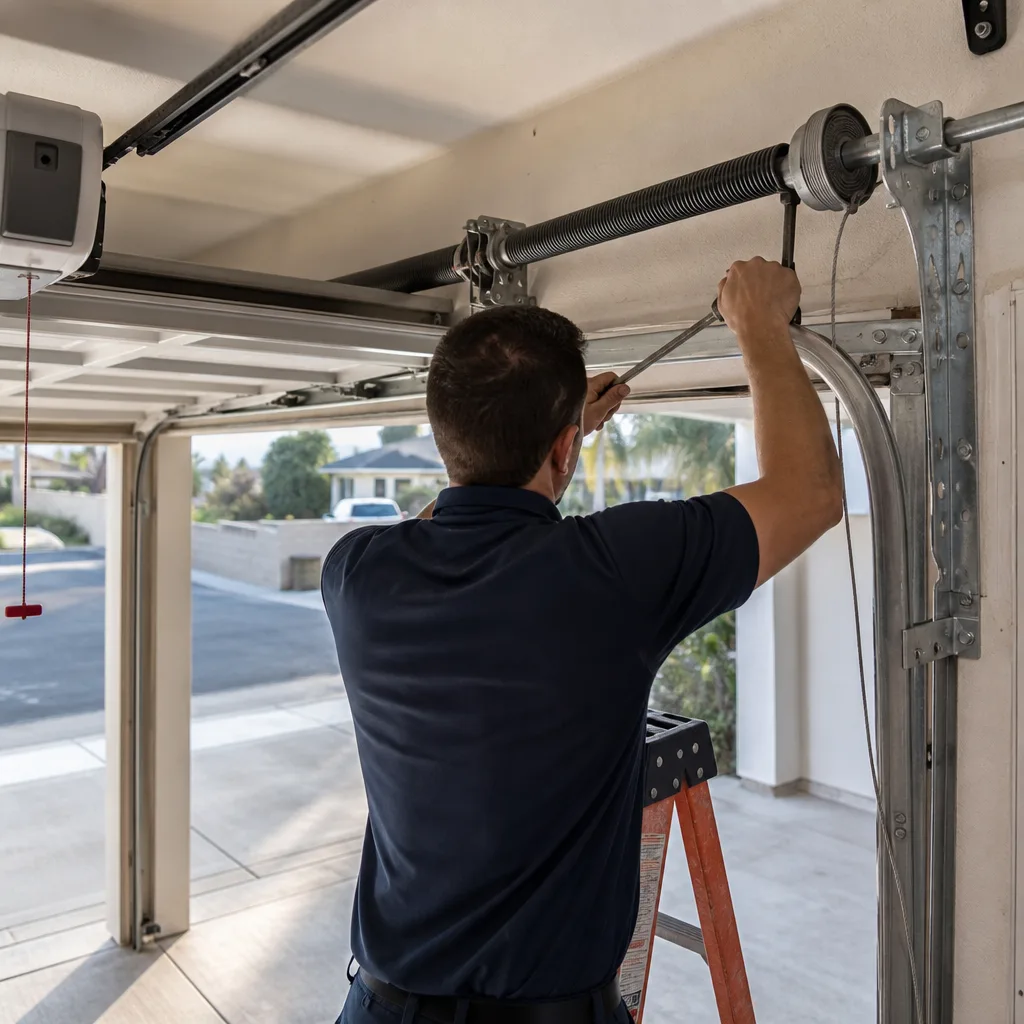 After
AfterThe Complete Guide to Garage Door in Encinitas
Most garage door guides are written for the American middle - Kansas City weather, standard tract homes, and inland humidity patterns. Encinitas is none of that. You’re half a mile from the Pacific, your door faces prevailing onshore wind, and the salt starts working on bare steel the day it’s installed. We’ve seen untreated torsion springs rust through in eighteen months on homes west of El Camino Real, while identical hardware lasts eight years inland. This guide maps every decision - material, hardware, insulation, opener - to the actual conditions on the ground here, from Leucadia’s beach cottages to Olivenhain’s ranch estates.
Quick Answer
A garage door in Encinitas must withstand salt air corrosion, marine layer moisture, and canyon wind gusts that standard inland doors never face. For coastal homes, galvanized and powder-coated hardware is essential, wind-load ratings should exceed San Diego County minimums, and material choices must balance HOA architectural rules with corrosion resistance. Most Encinitas homeowners replace their doors every 12-15 years, though coastal exposure can cut that to 8-10 years with inferior hardware.
Table of Contents
- Why Encinitas Is Different: Coastal Conditions That Destroy Standard Doors
- Materials That Actually Hold Up Here
- Hardware and Corrosion: The Hidden Failure Point
- Wind-Load Ratings: Why Canyon Homes Need More
- Insulation R-Value: What Coastal Mediterranean Climates Actually Need
- HOA Rules and Neighborhood Style: A Decision Tree
- Garage Door Opener Considerations for Encinitas
- A Maintenance Schedule That Matches Real Conditions
Why Encinitas Is Different: Coastal Conditions That Destroy Standard Doors
Encinitas sits at a geographic intersection that creates unique stress on garage doors. The city spans roughly six miles of coastline, but elevation changes from sea level to over 600 feet in the eastern canyons. That variation matters more than most homeowners realize.
Salt air corrosion begins within two miles of the beach. Marine layer moisture carries dissolved sodium chloride inland, depositing it on metal surfaces. We’ve measured surface rust on untreated steel hardware within six months on homes west of Vulcan Avenue in Leucadia. The corrosion accelerates where condensation forms on cooler morning surfaces, which happens frequently during May Gray and June Gloom periods.
Wind patterns differ from inland San Diego County. Encinitas experiences prevailing onshore winds from the west-northwest, with afternoon sea breezes that can sustain 15-25 mph for hours. Canyon-adjacent homes in New Encinitas and Olivenhain face channeling effects that create localized gusts well above ambient readings. Standard doors rated for basic wind loads flex under sustained pressure, stressing tracks and opener mounts over time.
Temperature moderation is often cited as a coastal benefit, but it creates its own problems. Encinitas rarely freezes, so homeowners assume insulation matters less. The reality: moderate temperatures with high humidity cause different material stresses than thermal cycling. Wood doors absorb moisture without drying cycles. Steel skins sweat against uninsulated interiors. These conditions don’t exist in Phoenix or Denver, and generic advice from those markets fails here.
We’ve replaced doors in Encinitas that failed in four years because they were specified for inland Temecula conditions. The homeowner saved $200 on the initial purchase and paid $1,800 for premature replacement. That’s not a square deal. See our Garage Door Cost Breakdown: The Encinitas Homeowner’s Reference for 2026 for realistic local pricing.
Materials That Actually Hold Up Here
Material selection for an Encinitas garage door starts with honest accounting of your home’s distance from the coast and its exposure to prevailing wind. Here’s how the common options perform in actual local conditions.
Steel doors remain the most common choice, but specification details determine lifespan. For coastal Encinitas, we specify 24- or 25-gauge steel minimum with a baked-on polyester or polyurethane finish. Galvanized substrate is non-negotiable west of El Camino Real. We’ve seen non-galvanized steel doors develop perforating rust in five years on ocean-view homes in Cardiff-by-the-Sea, which shares Encinitas’s coastal conditions. Clopay and Amarr both offer coastal-grade steel collections with enhanced substrate protection.
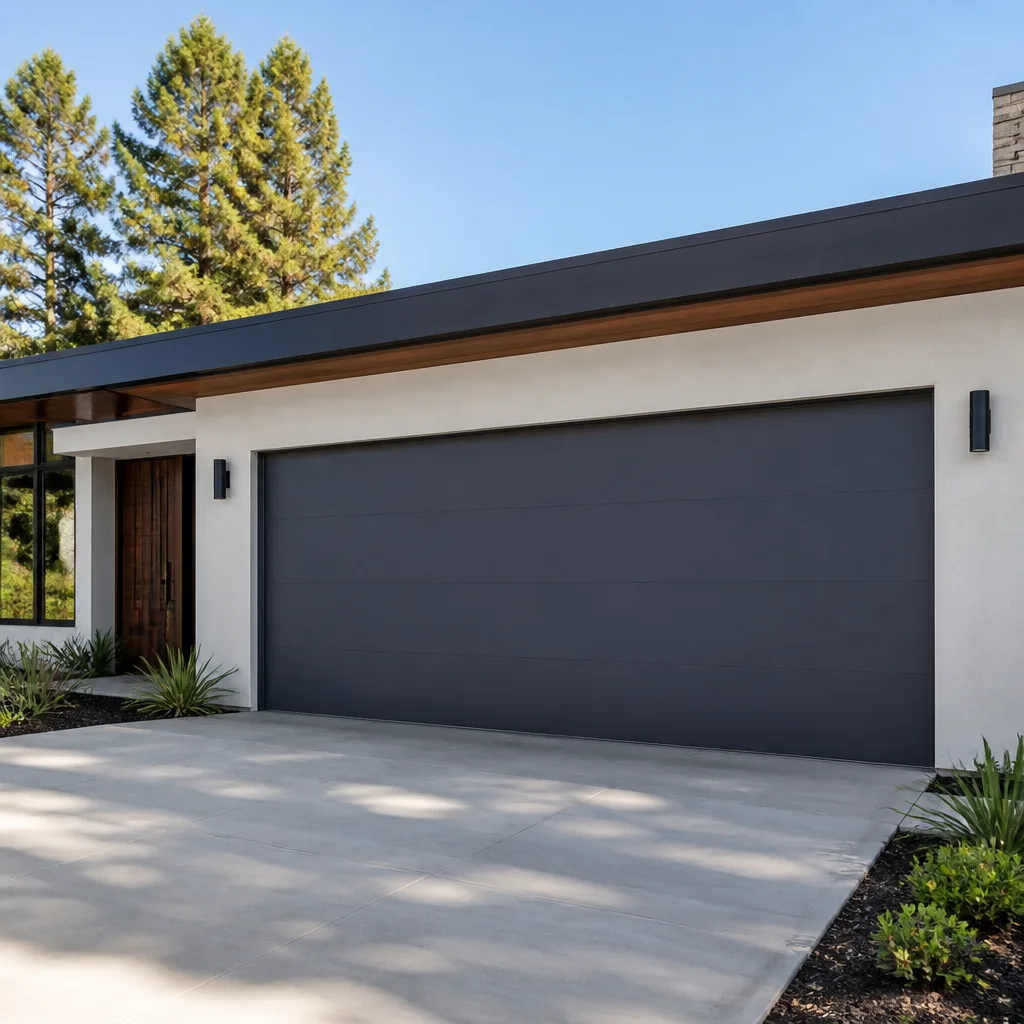
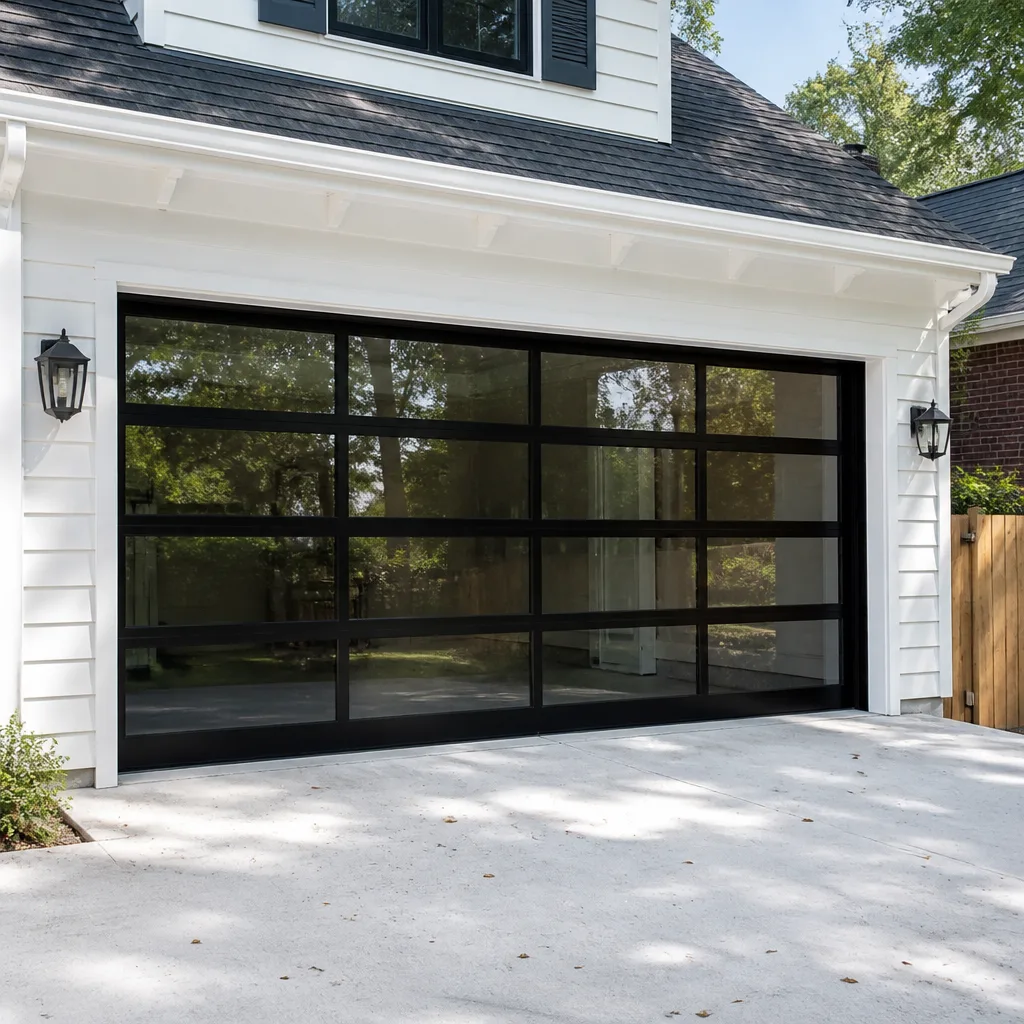
Aluminum and glass panel doors have gained popularity in modern Encinitas builds, particularly in Leucadia and along the 101 corridor. The aluminum frame resists salt corrosion better than steel, but the anodized finish quality varies significantly. Specify architectural-grade anodizing (AA25 minimum) rather than standard commercial grade. Glass panel doors also introduce thermal performance questions - more on that in the insulation section.
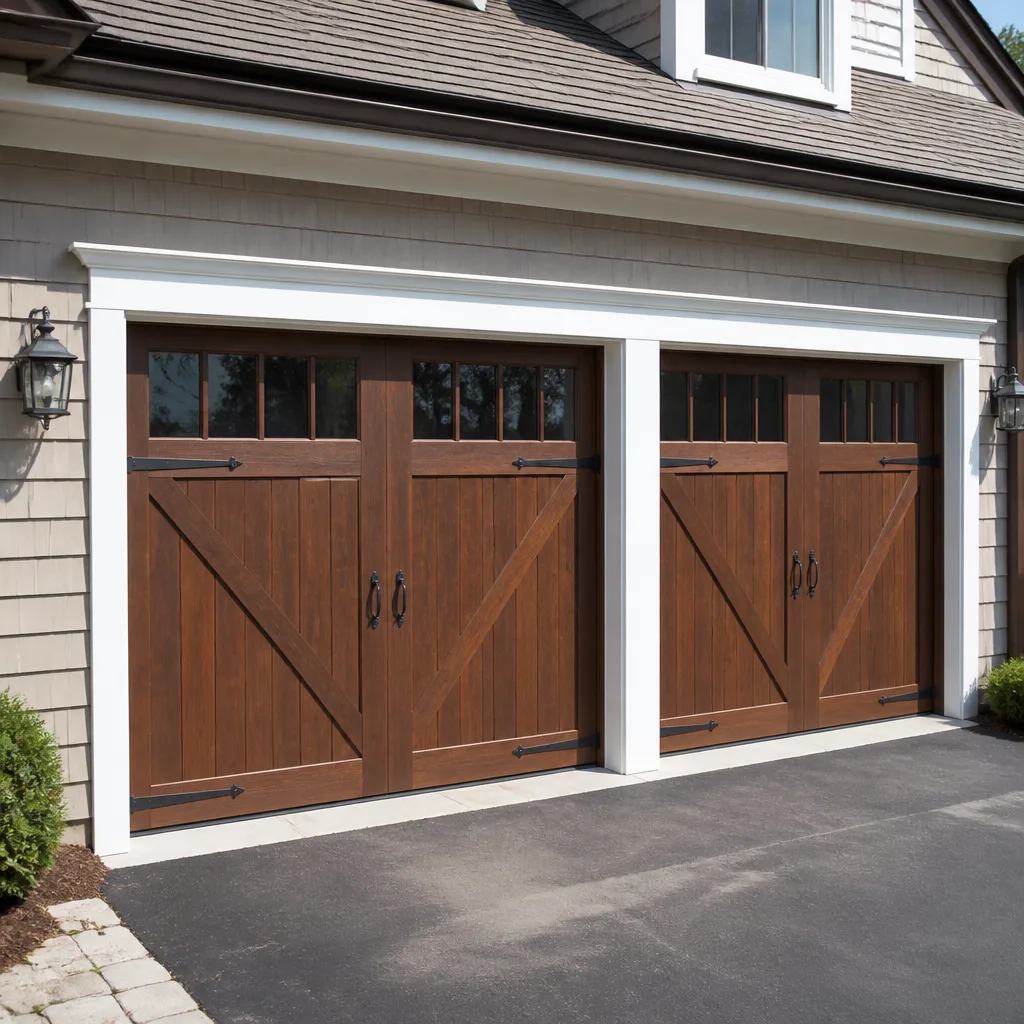
Wood and wood-composite doors suit the craftsman and Spanish colonial styles common in Olivenhain and the historic district. Solid wood requires diligent maintenance: resealing every 2-3 years, hardware inspection for galvanic corrosion where steel fasteners meet the wood. Wood-composite options from Wayne Dalton and others offer better dimensional stability but verify that the composite substrate is rated for exterior moisture exposure, not just interior humidity.
Fiberglass doors occupy a middle ground that works well for some Encinitas homes. The material doesn’t corrode and resists salt air, but UV degradation is the failure mode here. Lower-grade fiberglass yellows and becomes brittle in direct sun. We’ve replaced fiberglass doors on south-facing garages in New Encinitas after seven years of sun exposure. Specify UV-stable gel coat if you choose this route.
Key material selection factors for Encinitas:
- Distance from coast: under 1 mile demands galvanized substrate; under 2 miles strongly recommended
- Primary door facing: west and southwest exposures see worst salt and sun
- HOA architectural requirements: may restrict material options before performance enters the discussion
- Budget reality: spending 15-20% more on substrate and finish typically doubles door lifespan in coastal conditions
Hardware and Corrosion: The Hidden Failure Point
The door itself gets attention. The hardware gets ignored until it fails. In Encinitas, hardware failure is where we see the most preventable problems.
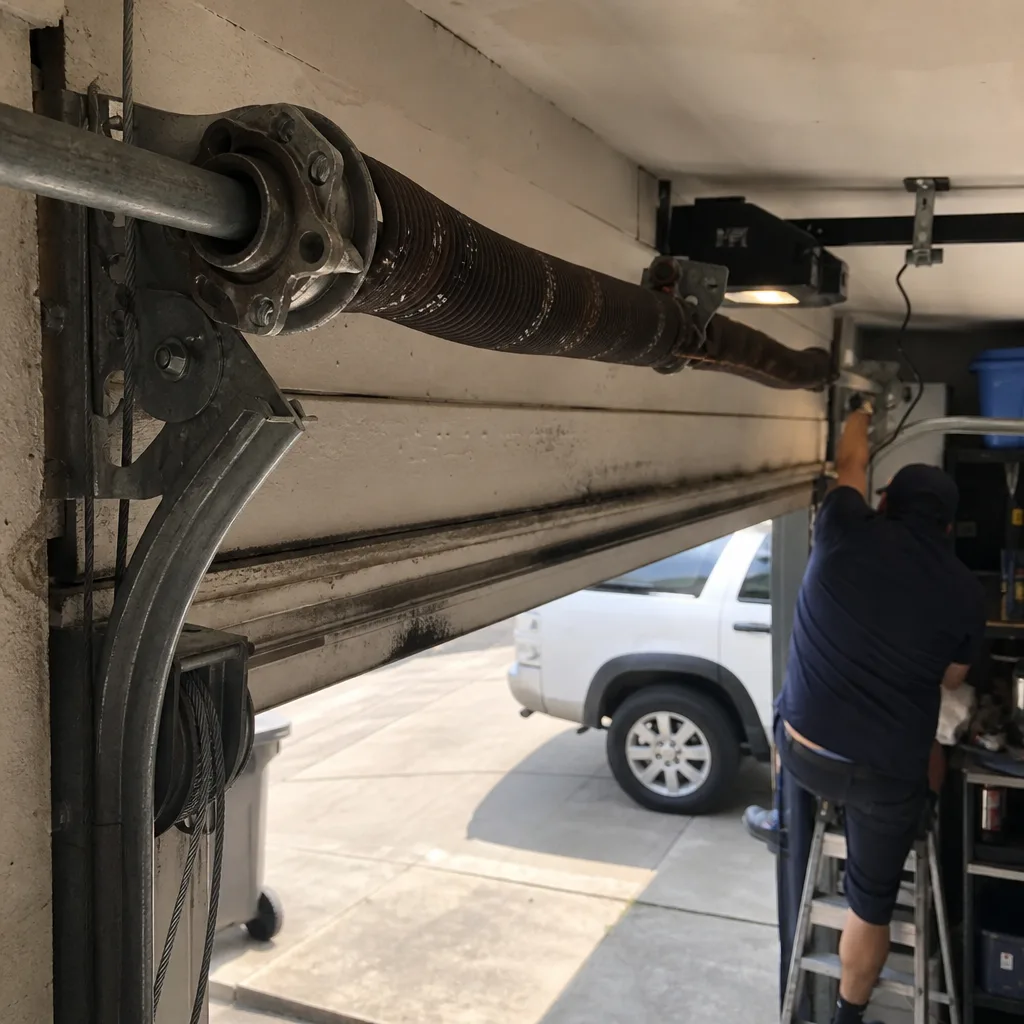
Torsion springs carry the entire weight of your door. They’re made of high-carbon steel, which is strong but vulnerable to corrosion. A standard oil-tempered spring in coastal Encinitas develops surface rust within two years. That rust pits the wire, creating stress concentrators. We’ve documented spring failures at 8,000 cycles in Leucadia - less than half the 15,000-20,000 cycle life expected inland. The failure is sudden and dangerous: a broken torsion spring releases stored energy instantly.
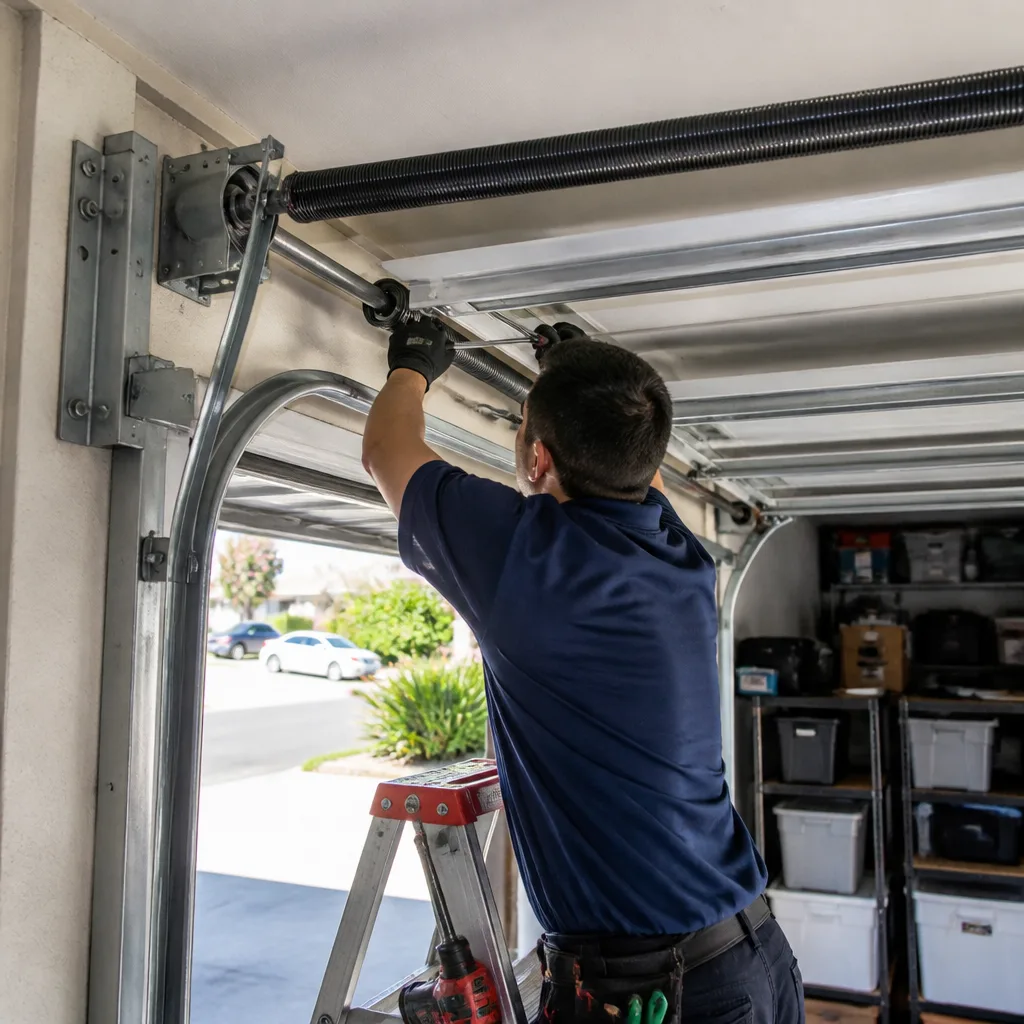
For coastal Encinitas, we specify galvanized or coated torsion springs. Some manufacturers offer stainless steel options, though the cost increase (typically 40-60%) is hard to justify for most homeowners. A more practical approach: galvanized springs with a regular inspection schedule, replacement at 10,000 cycles regardless of apparent condition.
Hinges, rollers, and track hardware face the same salt air. Standard zinc-plated hardware shows white corrosion (zinc oxide) within a year on coastal homes. That corrosion progresses to base metal, and soon hinges bind or rollers develop flat spots. We install powder-coated or stainless hardware on every Encinitas job within a mile of the coast. The cost difference is $80-$150 on a standard door. The replacement cost if you skip it: $400-$600 in labor and parts, plus the inconvenience of a stuck door.
Cables are particularly vulnerable because they’re drawn across pulleys and drums, flexing the wires. Corrosion between strands is invisible until failure. In our experience, cable life in coastal Encinitas is 60-70% of inland life. We inspect cables at every service call and recommend proactive replacement at visible wear, not waiting for failure.
Bearing plates and opener mounting brackets are the final hardware category. These structural elements transfer door and opener loads to the garage framing. Corrosion here is slow but consequential - we’ve seen mounting brackets rust through completely on twenty-year-old installations in Cardiff, creating a safety hazard as the opener pulls against weakened support.
Hardware specification checklist for Encinitas:
- Galvanized or coated torsion springs, inspected annually
- Powder-coated or stainless hinges and rollers within 2 miles of coast
- Stainless steel cables on coastal installations, inspected biannually
- Galvanized or powder-coated track and mounting hardware
- Lubrication with silicone-based or lithium-based grease every 6 months, not WD-40 (which displaces moisture briefly then evaporates, leaving metal exposed)
The company name references the mainspring, the component that carries the door’s entire weight. We chose it deliberately - this is the part that matters most, and the part most often underspecified.
Wind-Load Ratings: Why Canyon Homes Need More
San Diego County requires wind-load ratings on garage doors based on basic wind speed maps. The county minimum is 85 mph for most residential construction. That minimum is inadequate for significant portions of Encinitas.
Wind-load basics: The rating measures pressure resistance in pounds per square foot (psf), derived from design wind speed and exposure category. A door rated for 20 psf resists roughly 90 mph winds. One rated for 30 psf resists approximately 110 mph. The rating applies to the complete assembly - door, track, and hardware - not just the panel.
Encinitas-specific wind conditions: The coastal plain experiences sustained onshore winds that, while rarely damaging in isolation, create fatigue loading. More significant are the canyon and ridgeline effects. Homes in Olivenhain, eastern New Encinitas, and canyon-adjacent properties throughout the city experience wind acceleration as air masses compress through terrain features. We’ve measured localized gusts exceeding county design speeds during Santa Ana events, particularly in December through February.
When to exceed county minimums:
- Homes above 200 feet elevation: specify minimum 25 psf, 30 psf preferred
- Canyon-adjacent properties with channeling exposure: 30 psf minimum
- Large door openings (16-foot and wider): higher psf regardless of location, as larger spans flex more
- Homes with a history of track damage, opener mount loosening, or visible door flex in wind: upgrade at replacement
Code compliance reality: Building inspectors verify that installed doors meet submitted specifications. They don’t typically verify that specifications exceed minimums for local conditions. The burden of adequate specification falls on the homeowner and contractor. We’ve corrected installations where the minimum-rated door was code-legal but practically inadequate for the site’s wind exposure. For details on permitting, see Garage Door Permits, Codes & Inspections in CA: What You Need to Know.
Wind-load upgrades add $200-$500 to door cost depending on size and rating. Structural reinforcement of the garage opening may be needed for the highest ratings, adding $300-$800. For a home you’ll occupy for fifteen years, that’s predictable insurance against wind damage and opener stress.
Insulation R-Value: What Coastal Mediterranean Climates Actually Need
Garage door insulation is oversold with numbers designed for Minnesota. A door rated R-16 or R-18 sounds impressive, but the calculation method (center-of-panel measurement) overstates practical performance, and the climate need is different in Encinitas.
Understanding R-value in context: Encinitas has approximately 3,000 heating degree days annually and minimal cooling load. The temperature differential between garage and outdoors rarely exceeds 15°F for more than a few hours. In that context, the diminishing returns of high R-value are significant. An R-8 door in Encinitas performs nearly as well as an R-16 door in practical terms, because the driving force (temperature difference) is modest.
What matters more than R-value here:
- Air sealing: A poorly sealed R-16 door leaks more conditioned air than a well-sealed R-8. Focus on weatherstripping quality, threshold seal condition, and panel joint design. Wayne Dalton’s pinch-resistant panel joints, for example, reduce air infiltration beyond what the R-value suggests.
- Radiant barrier: Encinitas garages often overheat in afternoon sun, particularly west-facing doors. A radiant barrier facing the exterior reflects solar gain more effectively than additional conductive insulation. Some Clopay doors offer this as a factory option.
- Moisture management: Insulated steel doors with polyisocyanurate or polyurethane foam cores can trap moisture at the steel interface if the core isn’t fully bonded. In humid coastal conditions, we’ve seen delamination on lower-quality doors after 6-8 years. Specify fully bonded, moisture-resistant core adhesives.
Practical insulation guidance for Encinitas:
| Garage Use | Recommended Minimum | Notes |
|---|---|---|
| Storage only, no HVAC connection | R-6 to R-8 | Air sealing more important than R-value |
| Workshop or hobby space, occasional heating | R-8 to R-12 | Radiant barrier valuable for west-facing |
| Living space conversion or HVAC-connected | R-12 to R-16 | Full thermal break and air sealing essential |
| Glass panel or aluminum frame doors | Not applicable | Thermal break in frame; accept higher heat transfer |
We’ve installed R-18 doors in Encinitas and R-8 doors. The homeowner with the R-8 door and excellent weatherstripping typically reports more stable garage temperatures than the one with the R-18 and gaps at the sides. The numbers don’t tell the whole story.
HOA Rules and Neighborhood Style: A Decision Tree
Encinitas contains multiple HOA-governed communities with architectural guidelines that constrain garage door selection before performance enters the conversation. Understanding these constraints early prevents costly specification errors.
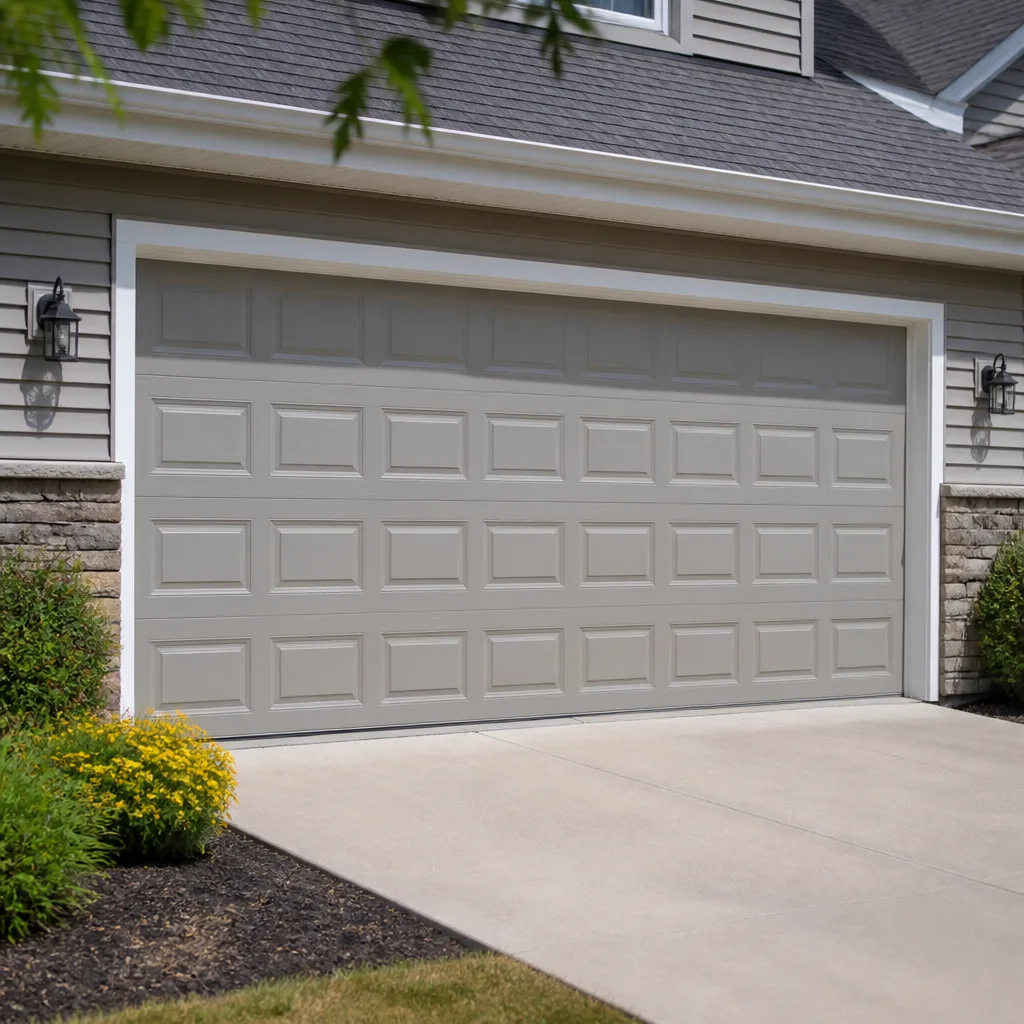
Olivenhain: The oldest planned community in Encinitas, with design guidelines favoring ranch and traditional styles. Doors are typically required to be flush or raised-panel steel in earth tones, or wood-look composites that match the area’s rural aesthetic. Glass panel doors are generally prohibited. We’ve worked with the Olivenhain Design Review Committee on multiple installations - early submission of manufacturer color samples and panel profiles prevents rejection.
Leucadia: More varied, with some beach cottage neighborhoods and newer infill. Architectural control is lighter in unincorporated pockets but present in planned developments. The coastal modern style common along the 101 corridor accepts glass panel and aluminum doors more readily. Color palettes trend lighter: whites, soft grays, and weathered wood tones that don’t fight the marine environment.
New Encinitas: Developed primarily in the 1980s and 1990s, with a mix of tract and custom homes. HOAs here often specify carriage house or traditional raised-panel styles. The key constraint is typically color rather than material - earth tones and muted greens that blend with the chaparral landscape.
Historic Encinitas (downtown and nearby): The city maintains design guidelines for the historic district. Garage doors on street-facing garages are expected to complement period architecture. We’ve installed custom wood doors with true divided lights on 1920s cottages here, and Spanish colonial reproductions with wrought-iron hardware on 1930s homes. The cost premium is 40-100% over standard steel, but the alternative is a citation from city planning.
Decision framework:
- Verify HOA or city design review requirements before selecting any door style
- Request written pre-approval for your specific manufacturer, model, and color
- Confirm that performance specifications (wind load, insulation) can be met within approved styles
- Schedule installation only after written approval, keeping documentation for any future dispute
We’ve been called to replace doors that passed HOA visual review but failed to meet the community’s wind-load requirements after the first Santa Ana season. The homeowner paid twice. Pre-approval of the complete specification, not just the appearance, prevents this. Our DIY vs Professional Garage Door: The Encinitas Homeowner’s Decision Guide explains when expert specification matters most.
Garage Door Opener Considerations for Encinitas
The opener works harder in Encinitas than most homeowners realize. Salt air affects electronics. Wind loading increases motor strain. And the convenience features that matter elsewhere may be secondary here.
Motor type and sizing: For the wind loads and door weights common in Encinitas, we specify 3/4 HP minimum for single doors and 1 HP for doubles. Belt drive is quieter and increasingly reliable, but chain drive tolerates salt air exposure better if the chain is properly lubricated. Screw drive, once common, has largely been displaced by belt and chain options from Genie, LiftMaster, and Chamberlain.
Smart connectivity: WiFi-enabled openers allow remote monitoring and control. In Encinitas, where many homeowners travel or maintain second homes, this has practical security value. We’ve installed LiftMaster myQ systems that alert owners to unexpected door operation, which matters in vacation-rental-heavy neighborhoods like Leucadia. The feature is only as reliable as your garage’s WiFi signal, which can be weak in detached garages or those with metal siding.
Battery backup: California requires battery backup on new opener installations. The requirement makes particular sense in Encinitas, where PSPS (Public Safety Power Shutoff) events during Santa Ana wind conditions can leave homes without power precisely when manual door operation is most difficult. Verify that installed battery backup meets the 24-hour standby, 10-cycle minimum specified in SB-969.
Safety systems: Photo-eye alignment is more critical in Encinitas than some markets because marine layer fog can reduce beam effectiveness if lenses are dirty or misaligned. We clean and test photo eyes at every service call. The auto-reverse force setting should be verified annually, as salt-corroded tracks increase rolling resistance and can trigger false reversals or, worse, inadequate reversal force.
Opener replacement timing: Most openers last 10-15 years. In coastal Encinitas, electronic component failure from salt air intrusion often precedes mechanical wear. We’ve replaced seven-year-old openers in oceanfront homes where circuit boards corroded. The cost of early replacement is typically less than repeated service calls for intermittent electronic faults.
For opener service and replacement in Encinitas, our technicians arrive with Genie, LiftMaster, and Chamberlain units on the truck, ready for same-day installation in most cases.
A Maintenance Schedule That Matches Real Conditions
Generic maintenance advice suggests annual service. For Encinitas, that’s insufficient for coastal homes and excessive for protected inland locations. Here’s a schedule calibrated to actual local conditions. For more guides & resources on coastal garage door care, explore our blog.
Monthly (all locations):
- Visual inspection of springs, cables, and rollers for rust or wear
- Test auto-reverse by placing a 2×4 flat on the threshold
- Listen for grinding, squealing, or irregular motor strain
Quarterly (within 1 mile of coast; biannual inland):
- Clean and lubricate track with silicone-based lubricant
- Wipe photo-eye lenses
- Inspect bottom seal for cracking or compression set
- Check weatherstripping at door sides and top
Annually (all locations):
- Professional inspection of spring tension and balance
- Tighten all hardware to specified torque
- Test force settings and travel limits
- Inspect opener mounting bracket and header attachment
Every 2-3 years (coastal); 4-5 years (inland):
- Replace torsion springs proactively, before failure
- Replace cables if any fraying or corrosion between strands
- Replace rollers if bearings show play or flat spots
Our $89 Seasonal Tune-Up covers the annual professional items with a written condition report. For coastal Encinitas homes, we recommend this every 8-10 months rather than annually. The cost of premature replacement far exceeds the cost of more frequent maintenance.
Common Mistakes to Avoid
- Buying on price alone for coastal locations. A $200 savings on a non-galvanized door becomes a $1,800 premature replacement. We’ve done the math on hundreds of Encinitas homes.
- Ignoring HOA pre-approval. Installing a non-compliant door in Olivenhain or a historic district triggers removal orders and double payment. Get written approval first.
- Specifying minimum wind load for canyon homes. The county minimum doesn’t account for terrain acceleration. Spend the extra $300-$500 on structural adequacy.
- Over-insulating for the climate. R-16 doors in unconditioned Encinitas garages waste money. Seal the air leaks instead.
- DIY spring replacement. Torsion springs store lethal energy. We’ve seen homeowners with broken wrists and worse. This is not a YouTube project.
- Neglecting hardware in “the door looks fine” assessments. The panel can look perfect while springs and cables corrode to failure. Inspect what you can’t see.
- Assuming all stainless steel is equal. Hardware marked “stainless” may be 400-series (magnetic, less corrosion-resistant) rather than 300-series. Specify 304 or 316 grade for coastal exposure.
When to Call a Professional
Some situations demand trained assessment. A door that reverses unpredictably, a spring that shows rust or gap in the coils, a cable that frays, or an opener that strains audibly - these are not maintenance items. They’re pre-failure warnings.
We don’t provide step-by-step DIY instructions for spring or cable work. The energy stored in a wound torsion spring can cause serious injury or death if released incorrectly. Our technicians are trained under our K.E.Y.S. values code - Krafted right, Every time, Your home first, Standing behind it - and arrive with the parts to complete most garage door repairs in Encinitas in a single visit.
Mainspring Garage Door Co. offers free estimates in Encinitas. Call (760) 565-5674 to schedule. We’ll assess your door’s condition, explain what we find, and quote a flat price before any work begins. No surprises on the bill.
Frequently Asked Questions
A new garage door in Encinitas typically ranges from $1,200 for a basic steel installation to $4,500 for custom wood or architectural glass panel doors, with most homeowners spending $1,800-$2,800 for a quality insulated steel door with coastal-grade hardware. Wind-load upgrades, custom sizing, and HOA-required styles add to base cost. We provide written, itemized quotes before any work begins. Call (760) 565-5674 for a free measure and exact price.
A properly specified garage door in Encinitas lasts 12-15 years inland and 8-12 years within a mile of the coast, with hardware life often shorter than panel life. Galvanized hardware, quality finishes, and regular maintenance extend lifespan significantly. We’ve seen neglected coastal doors fail in five years and meticulously maintained doors exceed twenty. The difference is specification and upkeep, not luck.
No. Torsion springs store enough energy to cause serious injury or death if released improperly. The winding bars must be inserted and removed in a specific sequence, and miscalculated tension causes dangerous operation. Our technicians carry specialized tools and training for safe spring replacement. The cost of professional replacement ($250-$450 for standard springs) is modest compared to emergency room bills or worse.
San Diego County requires minimum wind ratings on all new garage door installations. However, many Encinitas homes - particularly in Olivenhain, New Encinitas canyons, and elevated locations - benefit from exceeding the county minimum due to terrain-accelerated winds. We assess each home’s exposure and recommend appropriate ratings. The upgrade cost is typically $200-$500.
Approval depends on your specific community. Leucadia’s coastal modern areas often approve glass panel and aluminum frame doors. Olivenhain and historic Encinitas generally prohibit them. We recommend submitting manufacturer cut sheets and color samples for written pre-approval before ordering. We’ve assisted many Encinitas homeowners through this process successfully.
Most repairs are completed same-day because our trucks carry springs, cables, rollers, and openers from major brands including Genie, Clopay, and Amarr. Emergency calls receive priority dispatch. For new garage door installations in Encinitas, we schedule a free measure, provide a written quote, then order and install - typically within 1-2 weeks for standard sizes and styles.
The Bottom Line
A garage door in Encinitas must be specified for salt air, marine humidity, and wind conditions that generic advice ignores. Galvanized hardware within two miles of the coast, wind loads exceeding county minimums for canyon and elevated homes, insulation matched to moderate climate rather than oversold R-values, and HOA-aware style selection - these are the decisions that determine whether your door lasts eight years or eighteen. The upfront cost difference is modest. The replacement cost of getting it wrong is not.
We’ve served this community since 1984. Our trucks carry the parts to finish most jobs in one visit, and every job carries our 90-Day Done Right Promise in writing. If you’re considering a new door or need honest assessment of your current one, call (760) 565-5674. We’ll quote the flat price before the wrench comes out, and we’ll be there when we say.
Written by Carl Dutton, Owner at Mainspring Garage Door Co., serving Encinitas since 2016.