
Last updated September 10, 2026
Full 25-point door and opener safety check with every visit - springs, cables, rollers, tracks, and your LiftMaster or Chamberlain opener included
You get a price before we start. It does not change when the truck arrives.
 Before
 After
After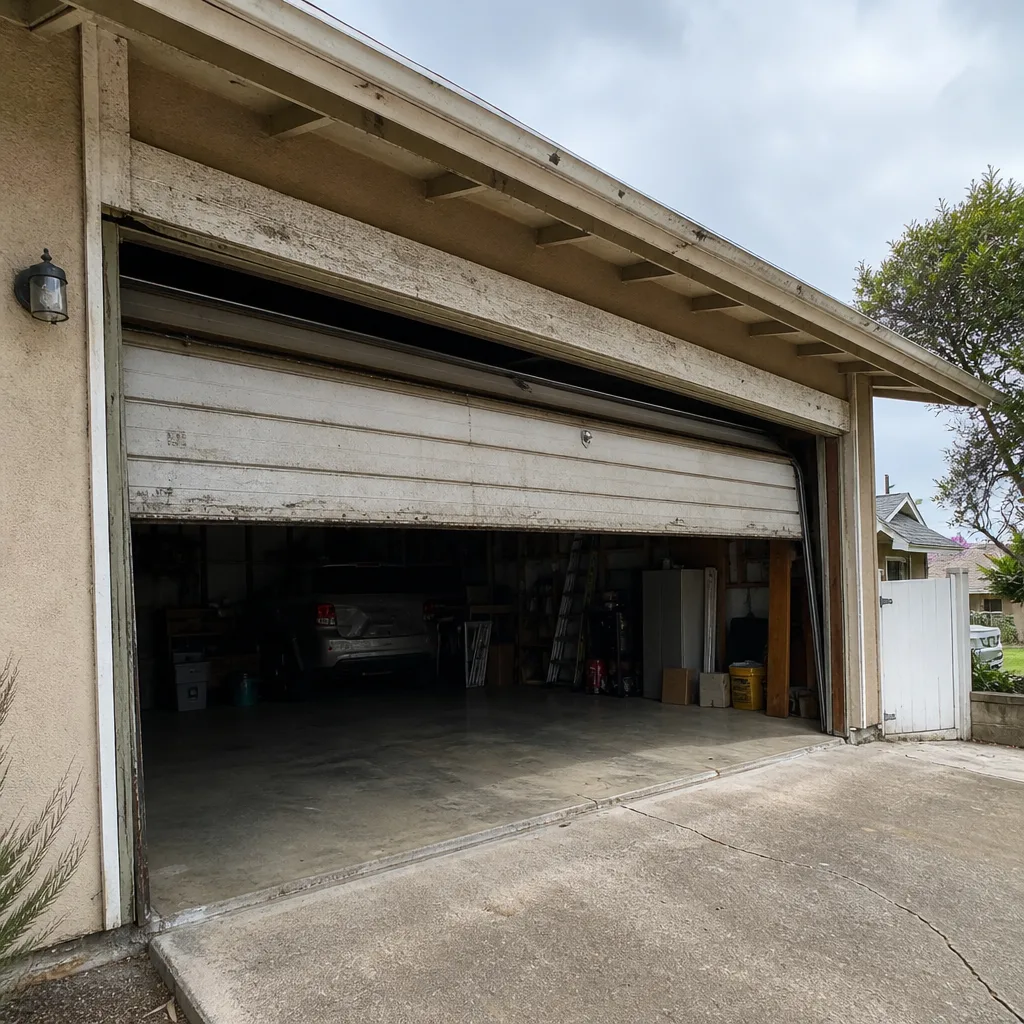 Before
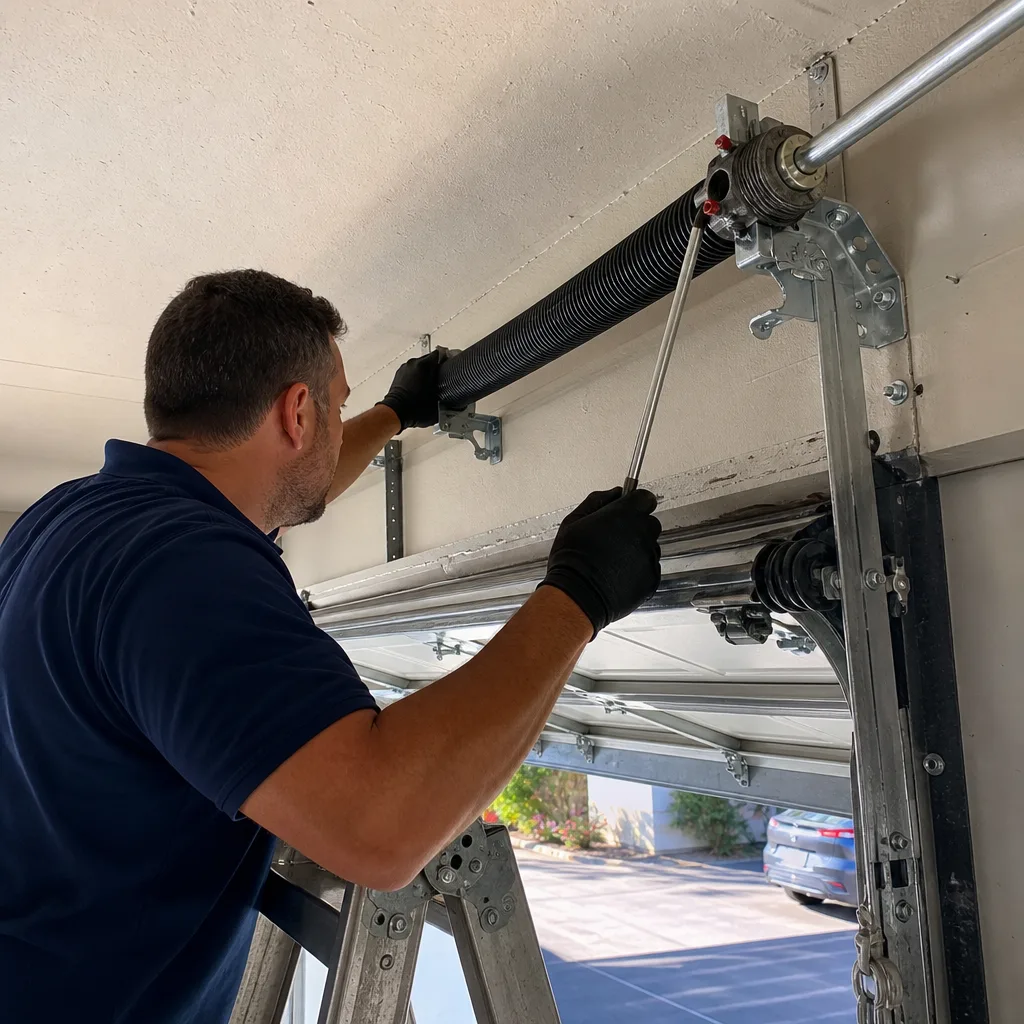 After
After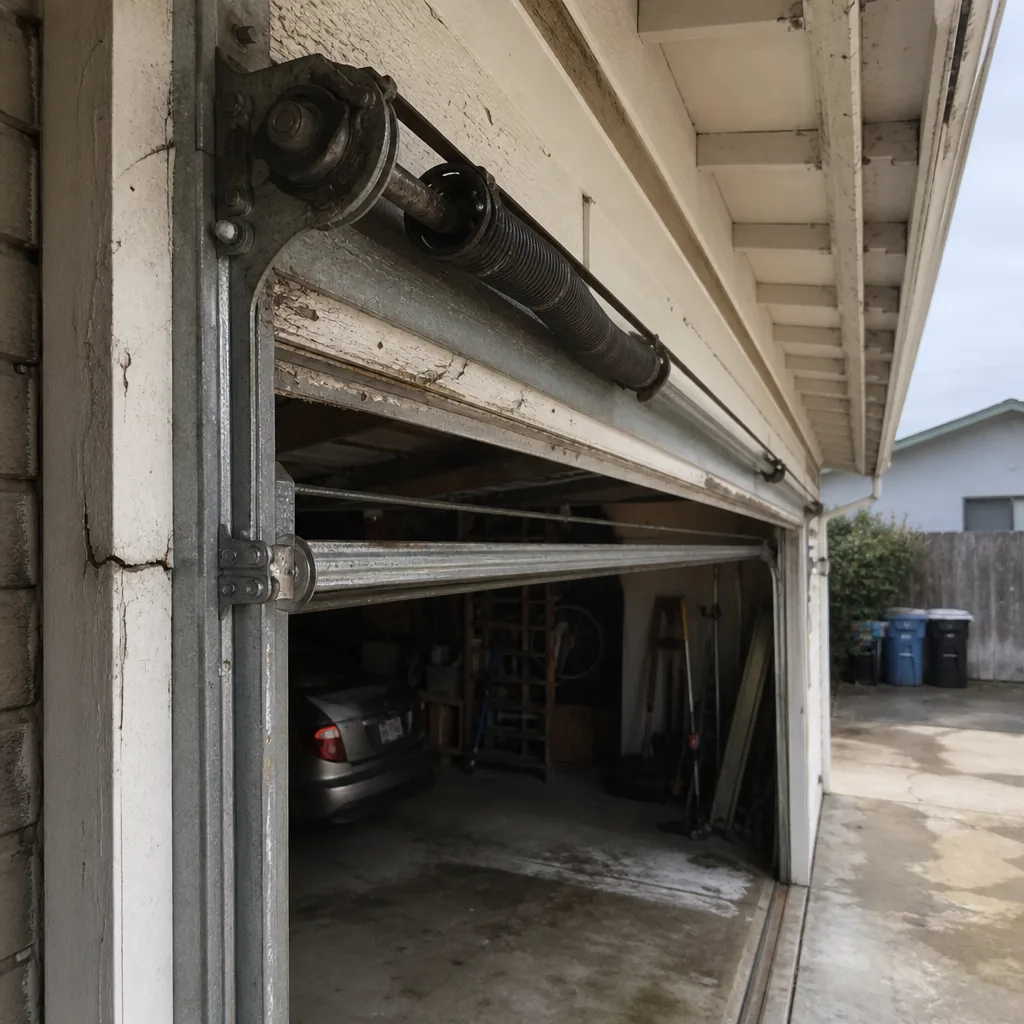 Before
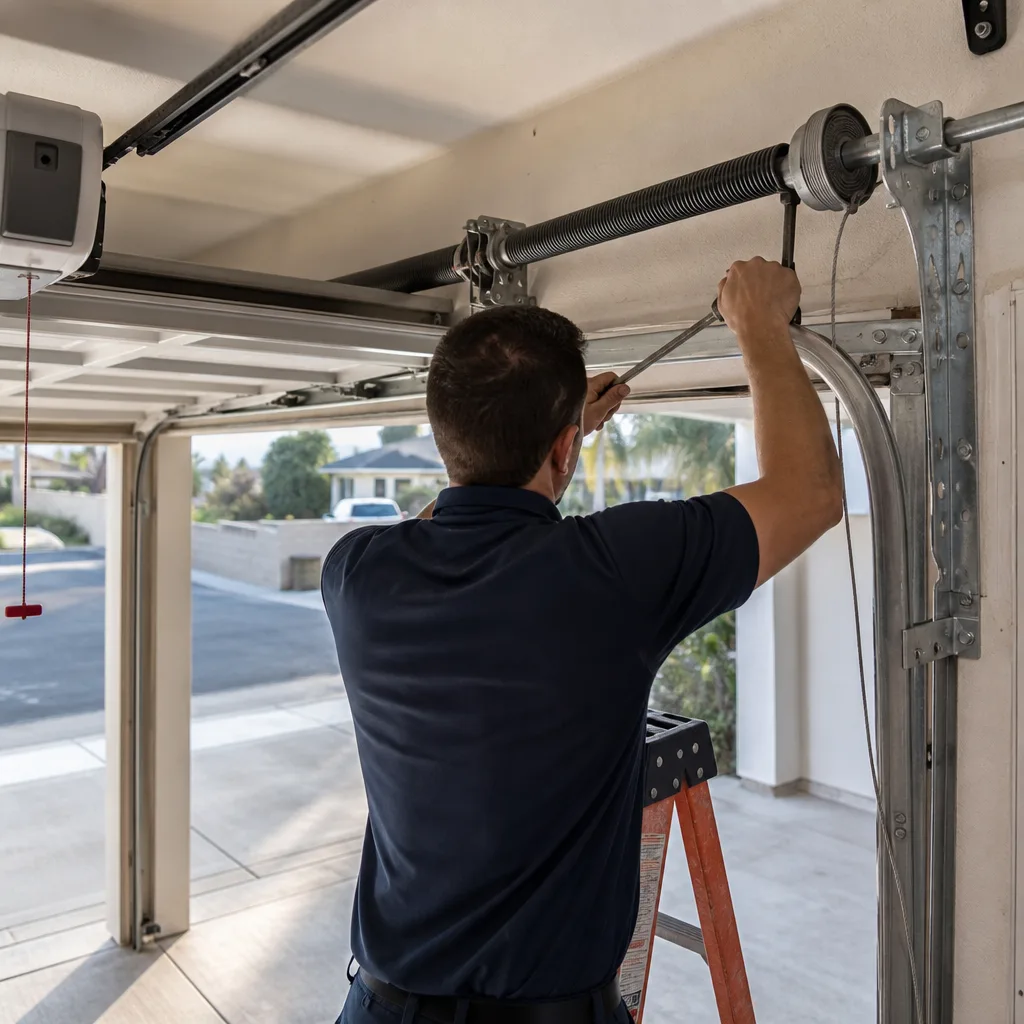 After
AfterGarage Door Warning Signs: A Encinitas Homeowner’s Reference Guide
A grinding noise on the way up is not the same as a grinding noise on the way down. One is a worn roller. The other is a cable skipping off a drum. In our 42 years serving Encinitas and North County, we’ve answered thousands of calls that began with “it’s making that grinding thing,” and the repair that followed ranged from a $15 roller swap to a full cable-and-drum rebuild. Most garage door failures announce themselves weeks in advance through sounds, movements, and visual cues that homeowners dismiss as normal wear. Our Complete Guide to Garage Door in Encinitas decodes exactly what those signals mean, which ones require same-week attention, and which ones mean stop using the door today.
Quick Answer
Garage door warning signs fall into four categories: sounds (grinding, popping, squealing, rhythmic thumping), visual wear (frayed cables, rust bloom, sagging sections), movement irregularities (slow operation, jerky travel, failure to stay open), and safety test failures (auto-reverse not triggering, balance off by more than a few inches). In Encinitas’s coastal climate, salt air accelerates cable rust and spring corrosion, making seasonal garage door care and visual inspection every three months more critical than inland. Any sign involving a broken spring, detached cable, or failed auto-reverse means stop using the door and call for service.
Table of Contents
- Sound-Based Diagnostic: What Your Garage Door Is Telling You
- Visual Signals Every Encinitas Homeowner Should Check
- The Three Door Movement Tests You Can Run Safely
- Three Warning Signs That Mean Stop Using the Door Today
- How Encinitas’s Coastal Climate Accelerates Wear
- How to Document Warning Signs Before You Call
- Common Mistakes to Avoid
- When to Call a Professional
- Frequently Asked Questions
Sound-Based Diagnostic: What Your Garage Door Is Telling You
Homeowners in Encinitas, from Leucadia to Olivenhain, describe garage door noises with the same handful of words. The same word can mean three different problems. Here’s how to tell them apart.
Grinding
Grinding on the way up usually points to worn rollers. Steel rollers without ball bearings, common on doors installed before 2005, grind against the track as they lose their round profile. The sound is metallic, continuous, and follows the door’s speed. Grinding on the way down is different. It often means a cable is not seating properly on the drum, or the drum itself has developed grooves that catch the cable. This is more serious. An unseated cable can slip completely, causing the door to drop unevenly or jam crooked in the tracks.
If the grinding is rhythmic, matching the rotation of the opener’s sprocket or chain, check the opener’s drive gear. On LiftMaster and Chamberlain chain-drive units, the white nylon drive gear wears into a crescent shape and produces a characteristic grind-skip pattern every six seconds or so.
Popping or Snapping
A single loud pop, especially in the morning or after a cool night, is often a torsion spring winding cone slipping against the shaft. The spring has lost some of its set tension. This is the sound of a spring preparing to fail. In Encinitas’s mild climate, springs last roughly 10,000 cycles, or seven to ten years for a typical family. But we’ve replaced springs in Cardiff-by-the-Sea homes that failed at six years due to salt-air corrosion at the anchor points.
Multiple small pops during travel usually mean a section hinge is binding. The hinge pin catches, releases, catches again. Left alone, this ovalizes the hinge holes and eventually cracks the door section.
Squealing or Screeching
High-pitched squeal on startup, especially in damp weather, is dry rollers or dry bearings. The rollers on the ends of torsion spring shafts, called end bearings, are often overlooked. They seize gradually, and the squeal is the shaft rotating against stationary bearings. This loads the opener heavily. We’ve replaced Genie screw-drive openers in Encinitas that failed not from motor wear, but from years of pulling against seized end bearings.
Rhythmic Thumping
A thump-thump-thump matching wheel rotation means a flat spot on a steel roller, or debris in the track. A thump every time the door reaches the same height usually means a track bracket has loosened, allowing the track to flex outward and slap back. Check the lag screws at the horizontal track’s curve. In older Encinitas homes with wood framing, these can back out as the wood cycles through humid summers and dry Santa Ana winters.
What to Say When You Call
Describe the sound, when it happens (going up, going down, or both), and whether it matches a specific position in the door’s travel. This lets a technician load the right parts before dispatch. Garage door repair in Encinitas moves faster when the diagnosis starts before the truck leaves the shop.
Visual Signals Every Encinitas Homeowner Should Check
Coastal homeowners face a specific challenge: distinguishing surface rust bloom from active cable corrosion that threatens failure. Here’s what to look for during a quarterly inspection.
Cable Condition: Bloom Versus Corrosion
Surface rust bloom on garage door cables looks like a light orange dusting. It wipes off with a cloth and leaves the underlying strands intact. This is common in Encinitas within a mile of the coast, especially on east-facing doors that catch morning marine layer. It is not immediately dangerous, though it signals that lubrication and inspection frequency should increase.
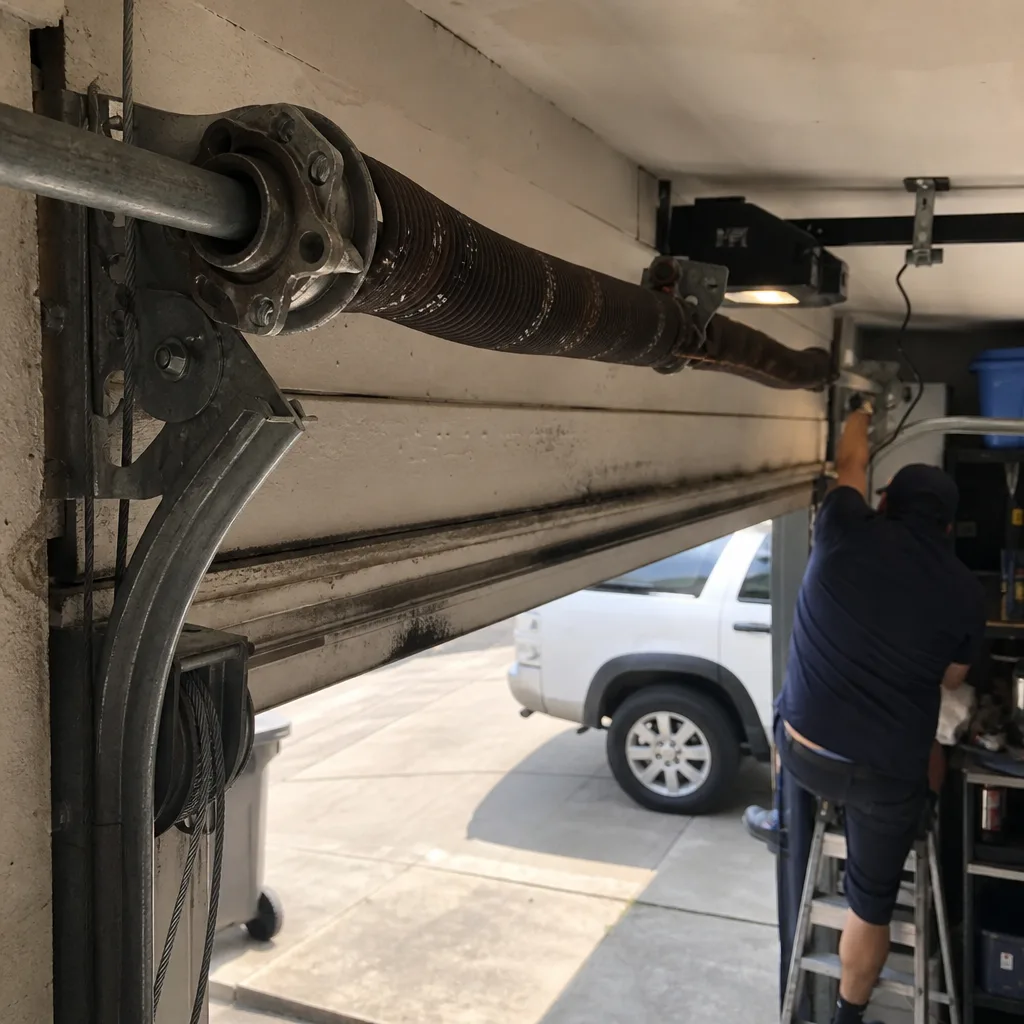
Active corrosion looks different. The cable strands become fuzzy, with individual wires fraying outward like a broom’s worn bristles. You may see pitting, or a section where the cable has flattened from internal strand breakage. This cable is losing strength unevenly. When one side fails, the door drops crooked and can jump the track. We’ve responded to emergency calls in New Encinitas where a corroded cable let go at 6 a.m., leaving the door jammed half-open with a car trapped inside.
Spring Tension Loss Before Breakage
A torsion spring that has lost tension does not always look broken. Check for these signs:
- The door feels heavier to lift manually, or the opener strains on startup
- The spring coil gaps have narrowed; a healthy spring shows even spacing between coils
- The spring has a visible gap or separation in the coil body, sometimes with rust bleeding from the break point
- The door drifts closed from the fully open position instead of staying put
In Encinitas’s climate, springs corrode from the inside out. The galvanized coating protects the surface, but moisture at the anchor points works inward. A spring can look intact while having lost 30 percent of its tension.
Door Section Alignment and Sagging
Stand inside the garage with the door closed and look across the bottom section. A gap between the section and the floor on one side, or visible bowing in the middle, indicates a structural issue. Wooden doors in Encinitas’s older neighborhoods, particularly in the Village and along Highway 101, absorb moisture from marine air and can sag as the stiles weaken. Steel doors may show oil-canning, a visible flex between reinforcement struts, if the struts have loosened or the door is oversized for its hardware.
Track and Hardware
Check the vertical tracks for dents or impact damage. Even a small dent from a bicycle handlebar or trash can can bind the rollers. Look at the jamb brackets where the track mounts to the wall. Cracked or rusted brackets transfer load unevenly and can tear out of the framing.
Weatherstrip and Bottom Seal
A deteriorated bottom seal lets water and rodents in, but it also changes the door’s closing geometry. The seal acts as a cushion. When it compresses unevenly, the door can twist slightly on each cycle, stressing the hinges and rollers. In Encinitas, UV exposure degrades vinyl seals faster than inland; inspect them twice yearly.
The Three Door Movement Tests You Can Run Safely
These tests require no tools and take under five minutes. They reveal problems that visual inspection misses. Run them monthly.
Test 1: The Balance Test
- Close the door fully.
- Pull the emergency release cord to disconnect the opener. The cord hangs from the trolley; pull straight down, then back toward the motor to release tension.
- Lift the door manually to waist height and release it gently.
A properly balanced door stays where you leave it, or drifts no more than a few inches in either direction. If it falls closed rapidly, the springs are under-tensioned or failing. If it rises on its own, the springs are over-tensioned. Both conditions overload the opener and create a safety hazard. Do not attempt to adjust spring tension yourself. The torque stored in a torsion spring can cause serious injury.
In our experience across Encinitas, from Rancho Santa Fe bordering properties to beach-close condos, roughly one in three doors we service fails this test. Homeowners often notice the opener “seems slower lately” without realizing the motor is compensating for spring degradation.
Test 2: The Resistance Test
- With the opener still disconnected, lift the door through its full travel.
- It should move smoothly, with consistent effort, no binding or catching.
Heavy resistance in one spot usually means a track misalignment, a damaged roller, or debris. A door that feels heavier at the bottom than the top suggests spring imbalance. Note the exact height where resistance changes. This information speeds diagnosis considerably.
Test 3: The Auto-Reverse Sensitivity Test
- Reconnect the opener by pulling the release cord toward the door, or by running the opener until the trolley re-engages.
- Place a 2×4 board flat on the floor, centered under the door path.
- Close the door using the remote or wall button.
- The door should reverse within two seconds of contacting the board.
If the door does not reverse, or reverses only after crushing the board, the force setting is too high. This is a documented injury risk, particularly for children and pets. Federal law (UL 325) requires this function since 1993, but settings drift over time.
Test the photoelectric sensors separately. Start the door closing, then wave a broom handle through the beam. The door should reverse immediately. In Encinitas’s bright coastal sun, sensors can be blinded by glare if poorly angled. We’ve found this especially on west-facing doors in late afternoon.
Important: If either safety test fails, stop using the door and call for service. Do not adjust force settings without understanding the underlying cause. A door that needs excessive force to close has a mechanical problem, not a setting problem.
Three Warning Signs That Mean Stop Using the Door Today
Some symptoms indicate active risk of injury or rapid structural damage. Continuing to operate the door in these conditions can turn a $200 repair into a $1,500 replacement, or worse.
1. Broken Spring
A broken torsion spring is unmistakable: a loud bang, a visible gap in the spring coil, and a door that feels twice its normal weight. The opener may try to lift anyway, straining the motor and potentially stripping the drive gear. More critically, a door with one broken spring in a two-spring system can rise crooked, binding in the tracks and risking a catastrophic drop.
Never pull the emergency release with a broken spring while the door is open. The full weight of the door, typically 150 to 250 pounds, will slam down uncontrolled. We’ve seen this damage cars, injure homeowners, and destroy the door itself.
2. Detached or Frayed Cable
A cable that has come off the drum, or shows three or more frayed strands in a one-inch section, can fail without warning. When one cable fails on a double-car door, the other side carries the full load momentarily, then typically fails as well. The door drops crooked, often jumping the track and bending sections or hinges.
If you see a cable dangling loose, or the door hangs lower on one side, do not operate it. Disengage the opener if the door is closed, and leave it that way.
3. Track Separation or Bent Vertical Track
A vertical track that has pulled away from the wall, or shows visible bending, means the door’s path is no longer controlled. Operating the door can force rollers out of the track, allowing the door to fall or jam. This is especially dangerous with an automatic opener, which applies force regardless of mechanical resistance.
In Encinitas, we’ve seen this after minor vehicle impacts that homeowners dismissed. A tap from a bumper can bend track without obvious damage, then worsen over weeks of normal operation.
How Encinitas’s Coastal Climate Accelerates Wear
Encinitas’s location between the Pacific and the coastal hills creates specific conditions that shorten garage door component life compared to inland San Diego County.
The marine layer brings salt-laden moisture that condenses on metal surfaces overnight, particularly on east and north-facing doors that stay shaded through morning. This accelerates corrosion at cable anchor points, spring anchor brackets, and bottom fixtures where water can pool. In Leucadia and along the 101 corridor, we’ve replaced cables at eight years that would last fifteen in Escondido.
UV exposure is equally significant. Encinitas averages 263 sunny days yearly. Plastic components, opener lens covers, remote control housings, and vinyl weatherstrip degrade faster than manufacturers’ inland ratings suggest. A door installed with a 25-year finish warranty may show chalking and color shift in ten years if it faces south or west without shade.
Temperature swing is milder than desert climates, but the Santa Ana events bring rapid humidity drops. Wood doors, still common in the Village and Olivenhain’s estate properties, shrink and swell through these cycles. Hinge screws loosen, panels crack at the stile joints, and the door’s weight distribution shifts gradually.
For homeowners in New Encinitas and developments east of El Camino Real, dust and pollen from the coastal sage scrub can accumulate in track lubricant, forming an abrasive paste. We see this as accelerated roller wear and noisy operation in homes less than five years old.
The practical response is quarterly inspection, semi-annual lubrication with a silicone-based product (never grease, which attracts grit), and earlier replacement of sacrificial components like cables and rollers before they reach theoretical end of life. Mainspring Garage Door Co. home service includes climate-specific recommendations based on your door’s orientation and exposure.
How to Document Warning Signs Before You Call
A clear description gets the right parts on the truck and the job done in one visit. Here’s what to record.
- Note the sound precisely. “Grinding on the way down, starting at about three feet from the floor, continuous until the door stops.” Not “it’s noisy.”
- Identify the door’s age and brand if known. A Clopay steel door from 2010 uses different hardware than an Amarr wood door from 1998. Check for a sticker on the inside top section or the track’s vertical piece.
- Run the three tests above and report the results. “Balance test: door falls from waist height. Auto-reverse: passes with 2×4, but photoelectric sensor only reverses if I block both eyes, not just one.”
- Photograph visible wear. A clear photo of cable fraying, spring condition, or track damage lets a technician confirm parts before dispatch. Most Encinitas homeowners can text these directly when they call.
- Describe recent changes. “Started two weeks ago after the rain.” “Got worse after my grandson hit the track with his bike.” Context matters.
When you call Mainspring with this information, we can often quote a firm price range before arriving, and our technicians arrive with springs, cables, rollers, and opener components matched to your description. Most jobs finish in a single visit because the diagnosis started with your observation.
Common Mistakes to Avoid
- Ignoring a change because “it’s always been like that.” A door that has always been noisy has always had a problem. Gradual degradation is still degradation, and the failure will eventually be sudden.
- Applying WD-40 to rollers or tracks. WD-40 is a solvent and water displacer, not a lubricant. It strips existing grease and attracts dust. Use a silicone-based garage door lubricant, or call for a proper tune-up.
- Adjusting spring tension or cable drums without training. Torsion springs store lethal energy. We’ve been called after well-intentioned homeowners turned a winding cone the wrong direction and released the spring uncontrollably. This is not a DIY repair.
- Replacing the opener when the door is the problem. A struggling opener is often a symptom. New openers on unbalanced or binding doors fail prematurely. Fix the door first, then assess the opener.
- Waiting for “both springs to go” before replacing. On two-spring systems, springs are matched. When one fails, the other is near failure and has been operating at uneven load. Replace both, or you’ll be calling again in months.
- Hiring based on the lowest bid without verifying licensing and insurance. In Encinitas, unlicensed operators are common. Verify a C-61/D-49 license through the California Contractors State License Board. Mainspring is fully licensed, insured, and bonded, with background-checked technicians on every job.
- Neglecting the emergency release. Test it quarterly. In a power outage or opener failure, you need to know it works smoothly. A seized release mechanism is a safety hazard.
When to Call a Professional
Call for same-day service if the door fails any safety test, operates unevenly, makes new loud noises, or shows visible cable or spring damage. Call for scheduled service if operation has gradually worsened, if the door is more than five years old without professional inspection, or if you’re unsure whether a symptom is serious-our step-by-step guide to hiring a garage door contractor in Encinitas explains what to look for.
Mainspring Garage Door Co. offers free estimates in Encinitas. Our phones are answered by a live person, 24 hours a day, including nights, weekends, and holidays. We quote the flat price before any work begins, arrive with the parts to finish most jobs in a single visit, and back every completed job with our 90-Day Done Right Promise in writing. Call (760) 565-5674 to describe what you’re seeing, or to schedule a $89 Seasonal Tune-Up that includes full inspection, lubrication, and safety testing, and explore more guides & resources on our blog.
Frequently Asked Questions
Most common repairs in Encinitas range from $150 for roller replacement to $450 for spring replacement on a standard two-car door. Cable replacement typically runs $180-$280. We state the flat price before any work begins, and our $50 Off Any Repair Over $250 standing offer applies automatically. Call (760) 565-5674 for an exact quote based on your door’s specific condition - estimates are free.
No. Torsion springs store enough torque to cause serious injury or death if released improperly. The winding cones, set screws, and cable tension all require specialized tools and training. In our 42 years, we’ve seen homeowners sustain broken wrists, facial injuries, and worse from DIY spring attempts. This repair should be performed only by a trained technician. Our background-checked, uniformed journeymen handle this work daily under our K.E.Y.S. values code.
Quarterly visual inspection and monthly safety testing are appropriate for Encinitas’s coastal climate. The marine layer and salt air accelerate corrosion on cables and hardware. Homes within a mile of the beach, particularly in Leucadia and along Highway 101, should inspect monthly during high-humidity months (May through October). Schedule professional service every two years, or annually for doors over fifteen years old.
Overnight temperature drop causes metal components to contract. Dry rollers and bearings bind slightly until movement generates enough heat to expand clearances. In Encinitas, this is most pronounced during Santa Ana conditions when humidity drops sharply overnight. The noise often disappears by mid-morning but indicates lubrication is needed. Persistent morning noise means the rollers or bearings are worn beyond the point where lubrication will help.
No. At Mainspring, the price we quote is the price you pay. If our technician finds additional problems during inspection, we explain them and quote separately before proceeding. You approve every charge before work starts. There are no surprises on the bill. This is part of our square-deal approach that has built our reputation since 1984.
Yes. Our Encinitas service trucks stock springs, cables, rollers, hinges, and opener components for all major brands including Wayne Dalton, Clopay, Amarr, and Genie. We also carry LiftMaster, Chamberlain, and Craftsman opener parts. Factory familiarity with these brands means we can match hardware correctly without ordering delays. Most repairs are completed in a single visit.
The Bottom Line
Your garage door sends specific, decipherable signals before it fails. The grinding noise on descent is not the same as the grinding noise on ascent. A cable’s surface bloom is not the same as active fraying. A door that fails the balance test is not merely “getting old” - it is actively damaging your opener and creating a safety risk. In Encinitas’s coastal environment, these signals accelerate. Quarterly inspection, monthly safety testing, and prompt response to the three stop-now warning signs will keep your door reliable and your household safe. When you’re uncertain what a symptom means, call for a free estimate. The right diagnosis early prevents the emergency call later.
Written by Carl Dutton, Owner at Mainspring Garage Door Co., serving Encinitas since 2016.